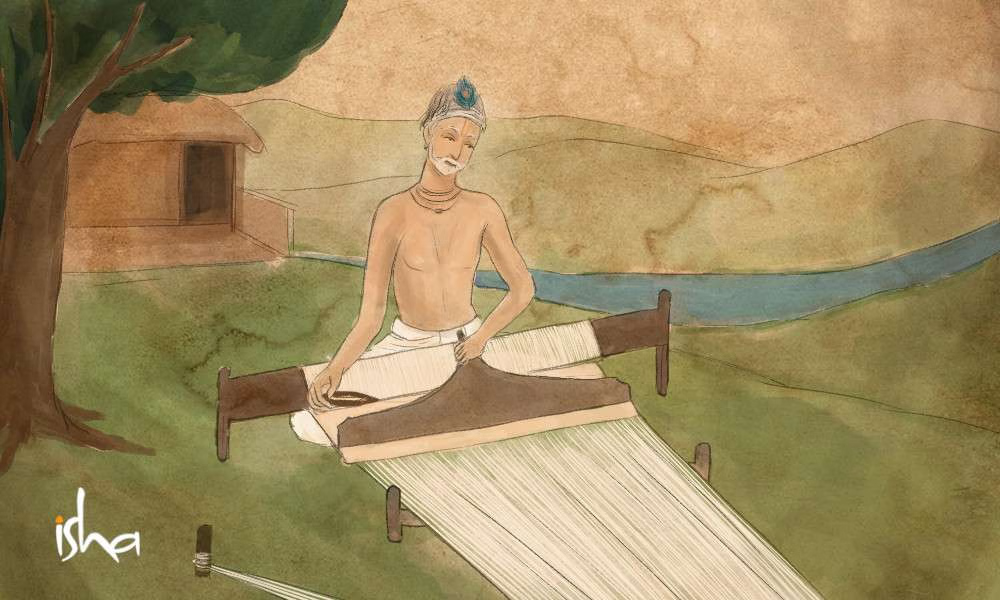
The Ocean of Unity: Understanding Kabir's Wisdom
In the profound words of Kabir, "He is the wave, He is the sea; He is the same," we are invited to explore the intricate relationship between the individual and the universal. This quote encapsulates a deep spiritual truth about the interconnectedness of all existence, suggesting that the essence of the divine permeates every aspect of life. The stakes of this understanding are high; recognizing our unity with the divine can transform our perception of self and other, leading to a more compassionate and harmonious existence.
As we delve deeper into Kabir's assertion, we uncover layers of meaning that challenge our conventional notions of separation and individuality. The imagery of waves and the sea evokes a sense of fluidity and continuity, urging us to transcend the boundaries that often define our identities. This exploration is not merely philosophical; it is a call to experience the divine presence in every moment, fostering a sense of belonging that transcends the transient nature of life.
The image / the metaphor
The metaphor of the wave and the sea is rich with implications. A wave, while distinct in its form and movement, is ultimately part of the vast ocean. This imagery suggests that while we may perceive ourselves as separate entities, we are, in essence, manifestations of a singular, unified existence. The verbs "is" and "same" emphasize a state of being that transcends duality, inviting us to recognize that our individuality is not separate from the divine source.
Diving deeper into this metaphor, we can see that the wave represents the transient aspects of life—our thoughts, emotions, and experiences—while the sea symbolizes the eternal, unchanging reality of the divine. This duality invites contemplation on the nature of existence itself. Just as a wave rises and falls, so too do our lives ebb and flow, yet the sea remains constant, embodying the eternal truth that underlies all phenomena. In this way, Kabir's words encourage us to embrace both our individuality and our unity with the divine.
In the speaker's tradition
Kabir's teachings are deeply rooted in the bhakti tradition, which emphasizes personal devotion and the intimate relationship between the seeker and the divine. Concepts such as dharma, or righteous living, and bhakti, the path of love and devotion, resonate throughout his poetry. In this context, the idea of unity is not merely philosophical; it is a lived experience that invites practitioners to dissolve the ego and recognize the divine presence in all beings. This process of kenosis, or self-emptying, aligns with the notion of fana, the annihilation of the self in the divine.
Moreover, Kabir's insights echo the Buddhist concept of sunyata, or emptiness, which suggests that the self is an illusion, and true understanding arises from recognizing our interconnectedness. In the context of bhakti literature, we can draw parallels with the works of other saints, such as Mirabai and Tulsidas, who similarly emphasized the importance of surrendering the self to experience the divine. Kabir's assertion serves as a reminder that the journey towards unity is both personal and collective, urging us to seek the divine in ourselves and in others.
Living the teaching
Consider a modern scenario where this teaching resonates: a moment of conflict in a workplace. When tensions rise, it is easy to view colleagues as adversaries, reinforcing the illusion of separation. However, by embodying Kabir's wisdom, one can shift perspective, recognizing that each person is a wave in the same ocean of existence. This understanding fosters empathy, allowing for a more compassionate approach to conflict resolution, where the focus shifts from winning to understanding and collaboration.
In the realm of personal relationships, Kabir's teaching can also illuminate the path to deeper connection. Imagine a difficult moment with a loved one, where misunderstandings create distance. By embracing the idea that "He is the wave, He is the sea," one can cultivate patience and compassion, recognizing that both individuals are expressions of the same divine essence. This perspective encourages open communication and forgiveness, transforming conflict into an opportunity for growth and deeper intimacy.
A reflection
As we reflect on Kabir's profound words, we are invited to contemplate our own relationship with the divine and with others. How can we embody the understanding that we are all waves in the same ocean? This question invites us to explore the ways in which we can dissolve the barriers of separation in our lives, fostering a sense of unity and compassion that transcends our individual experiences. In this contemplation, we may find the path to a more harmonious existence, rooted in the recognition of our shared essence.



Join the BrightStar Community
Stay connected with daily inspiration, event announcements, and community wisdom